 Meridian Palate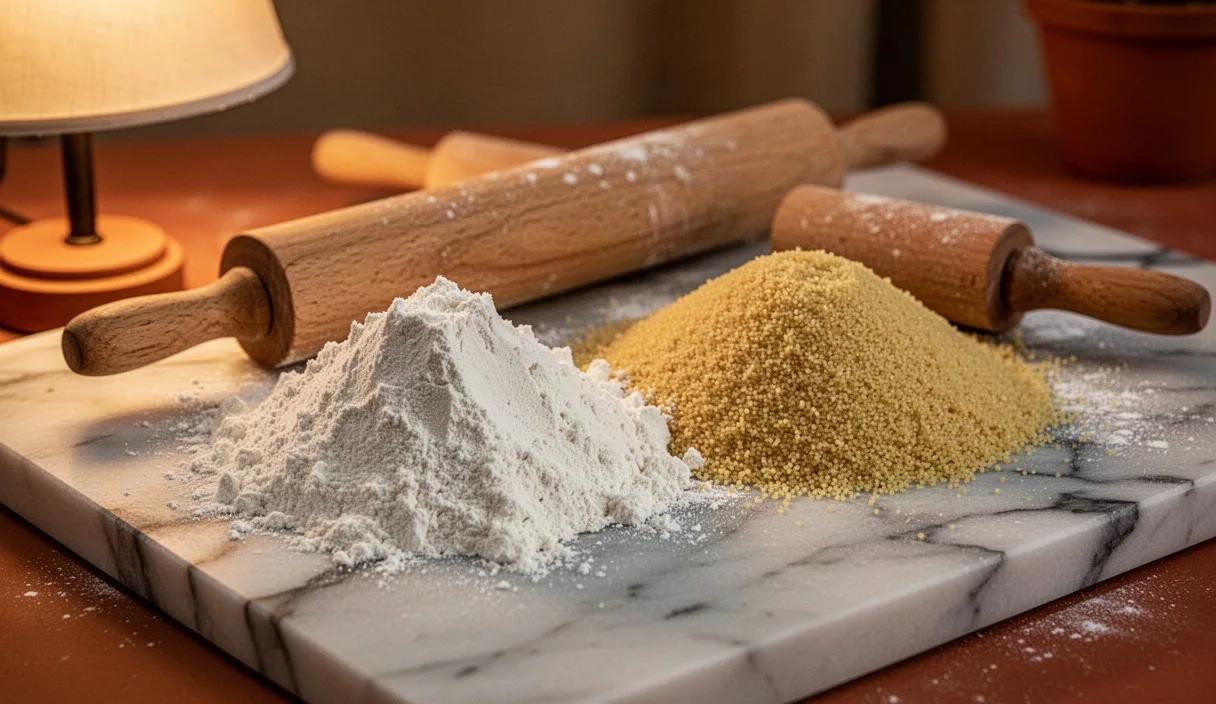

Walking into an Italian grocer to buy pasta flour often presents a wall of blue and red paper sacks, most labeled with numbers that look like code. If you pick up an all-purpose bag from a supermarket shelf, you might end up with an acceptable plate of noodles, but the chew and elasticity will rarely match what you intended. Flour is not an inert filler. It is a live collection of starch granules, enzymes, and proteins that dictate whether your dough sheets drape like velvet or snap like cardboard under the roller.
The divide between Northern and Southern Italian pasta traditions is fundamentally an agricultural map of grain. In the north, softer wheat varieties paired with rich egg yolks built the delicate stuffed pastas of Emilia-Romagna and the silk-thin ribbons of Piedmont. In the arid south, hard durum wheat milled into rough golden grains met plain warm water, producing resilient shapes that cling to oil-based sauces. Mastering both styles begins with understanding how milling specifications, mineral residues, and botanical origins govern gluten formation.
Flour Milling Grades and Ash Content Demystified
The Italian flour classification system is governed by presidential decree, specifically regulating the ash content and extraction rate of milled soft wheat (Triticum aestivum). Ash refers to the mineral content remaining after a test sample of flour is incinerated in a laboratory furnace at high temperature. Because minerals are concentrated in the outer bran and germ layers rather than the starchy endosperm, a lower ash count means the miller has removed nearly all traces of bran. The classification does not tell you protein strength; it tells you how finely the flour was sieved and how clean it is of outer husk fragments.
Tipo 00 is the most refined grade on the market. It has a legal maximum ash content of 0.55 percent and an extraction rate around 70 percent to 75 percent, meaning only the core of the endosperm makes it into the sack. Tipo 0 is slightly less refined, with an allowable ash ceiling of 0.65 percent. Tipo 1 and Tipo 2 retain progressively higher amounts of bran and germ, carrying ash contents up to 0.80 percent and 0.95 percent respectively. Whole wheat, or farina integrale, contains the entire grain and can register ash levels up to 1.70 percent.
When rolling pasta to thicknesses below one millimeter, bran particles act like tiny razor blades. Each shard of husk interrupts the continuity of the gluten sheet, creating micro-tears that rupture when boiled or filled. This is why Tipo 00 remains the standard for laminated sheet work. It yields a smooth, continuous surface capable of stretching thin enough to read newsprint through, provided the protein quality matches the milling grade.
| Italian Grade | Maximum Ash Content | Minimum Dry Protein | Best Culina Use |
|---|---|---|---|
| Tipo 00 | 0.55 percent | 9.00 percent | Egg pasta, delicate laminated ribbons, filled agnolotti |
| Tipo 0 | 0.65 percent | 11.00 percent | Rustic egg tagliatelle, focaccia, regional flatbreads |
| Tipo 1 | 0.80 percent | 12.00 percent | Hearty country noodles, rustic hand-cut maltagliati |
| Tipo 2 | 0.95 percent | 12.00 percent | Stone-ground sheet doughs blended with refined flours |
| Integrale | 1.70 percent | 12.00 percent | Robust extruded shapes, bigoli, rough pici |
Pay close attention to protein quality, usually indicated on commercial bags by a W index rating. A Tipo 00 pastry flour may contain only 8.50 percent weak protein, which turns to mush in boiling water. For fresh pasta, look for a Tipo 00 designated for fresh pasta (often marked per pasta fresca), which generally carries a protein content between 11.50 percent and 13.00 percent and a W rating between 220 and 260.
Soft Wheat Tipo 00 and Egg Yolk Doughs
Northern Italian pasta dough relies on the chemical partnership between soft wheat endosperm and whole eggs or additional egg yolks. Whole eggs are roughly 74 percent water, 12 percent protein, and 10 percent fat, with the remainder composed of trace minerals and carbohydrates. The yolk contains lecithin, a natural emulsifier that suspends fat droplets uniformly within the dough structure, coating the flour granules and producing an unmistakably tender bite.
When you hydrate Tipo 00 flour with egg yolks, the water content of the egg initiates gluten development, while the lipids physically slip between the glutenin and gliadin chains. This prevents the gluten network from becoming excessively tight or rubbery. The resulting matrix is supple, extensible, and elastic without being stubborn. You can roll an egg and Tipo 00 sheet down to setting number eight on a standard hand-crank machine without the sheet retracting rapidly like an exercise band.
For rich doughs such as Piedmontese tajarin, cooks often push the yolk proportion to extreme levels, sometimes using forty yolks per kilogram of flour with virtually no egg white. The high fat content delivers a deep golden color and a characteristic melt-in-the-mouth quality. However, doughs loaded with yolk dry out more quickly on the bench than water-based doughs. They demand brisk handling, immediate wrapping in parchment or plastic film, and attentive rolling.
Shapes cut from soft wheat and egg doughs must match this delicate internal structure. Long flat cuts like tagliatelle (typically cut to six millimeters wide), pappardelle (spanning twenty to twenty-five millimeters), and tagliolini (around two millimeters) show off the tender bite. Filled pastas like tortellini, ravioli, and agnolotti require the pliability of Tipo 00 so the edges seal firmly around wet fillings without developing hard, leathery seams during a brief simmer.
Durum Wheat Semolina for Southern Italian Shapes
Southern Italian pasta belongs to an entirely different botanical species: Triticum durum. Durum is an exceptionally hard wheat variety with a vitreous endosperm rich in carotenoid pigments, which give the flour its golden-yellow cast. When durum wheat is milled, it does not crush into a powdery dust like soft wheat. Instead, it fractures into gritty, crystalline particles known simply as semolina, or semola.
For hand-formed fresh pasta, coarse semolina straight from the first milling passes can feel like coarse beach sand and struggles to hydrate evenly under hand kneading. Pasta makers use semola rimacinata, which is durum wheat that has been milled a second time. Rimacinata retains the hard character and yellow pigments of durum but reduces the granule size so it absorbs ambient water rapidly without prolonged soaking periods.
Durum wheat contains substantial protein, frequently measuring between 13.00 percent and 15.00 percent by dry weight. However, the gluten formed by durum is markedly different from soft wheat gluten. It contains high levels of glutenin, giving it great tenacity and resistance to extension, but relatively low elasticity. This means semolina dough holds its shape with stubborn fidelity once molded, making it the ideal raw material for hand-shaped southern pasta.
- Orecchiette: The dough is rolled into thin ropes, cut into small nuggets, and dragged with the tip of a table knife across a wooden board before being inverted over a thumb. Durum dough retains the rough, cup-like depression without flattening out.
- Cavatelli: Grooved with two fingers against a textured board, these small rolled shells rely on the rigid structure of semola rimacinata to keep their hollow interior open while boiling.
- Busiate and Trofie: Twisted around thin brass rods or rubbed between palms, these shapes hold tight helical curls that would simply unwind and turn limp if made from soft Tipo 00 flour.
- Strangozzi and Pici: Hand-rolled thick cords that need structural body to avoid feeling like wet bread dough when cooked al dente.
Hydration Ratios for Both Flour Types
Hydration calculations for fresh pasta are traditionally expressed as baker's percentages, where total liquid weight is measured against total flour weight. Because egg water content differs from straight tap water, the two flour types require entirely distinct targets to hit workable dough consistencies.
For soft wheat Tipo 00 paired with whole eggs, a reliable baseline ratio is 57 percent liquid hydration. In standard kitchen measures, this translates to roughly one large whole egg (weighing fifty to fifty-two grams out of the shell) for every one hundred grams of Tipo 00 flour. If you enrich the dough with extra yolks, you must account for the lower water percentage of yolk (about 51 percent water) compared to egg white (about 88 percent water). An enriched formula might use one whole egg plus two extra yolks per one hundred grams of flour, accompanied by a teaspoon of cool water if the dough feels dry during the initial crumb formation.
Durum semola rimacinata paired with water demands a tighter ratio, usually between 46 percent and 49 percent total hydration. Because water contains zero fats or solids, every drop acts directly on the starch and protein. Warm water at roughly 40 degrees Celsius works best here; the warmth softens the hard starch granules and accelerates hydration without cooking the protein matrix.
Calculating Liquid by Flour Weight
- Weigh your flour on a digital scale in grams rather than using volume cups. Compacted semolina weighs significantly more per cup than aerated Tipo 00.
- For egg pasta, multiply the flour weight by 0.57 to find the target total egg weight. Crack the eggs into a bowl, whisk thoroughly, and pour the exact calculated gram weight into the flour well.
- For semolina water pasta, multiply the flour weight by 0.48. Measure water warmed to blood heat (lukewarm to the touch).
- Reserve two tablespoons of your measured flour to the side before mixing. Flours vary across brands and seasons; humidity in your kitchen can shift flour moisture by several percentage points. It is far simpler to knead extra flour into a slightly sticky mass than to force liquid into an over-floured, dusty lump.
Resting the Dough: Why Gluten Relaxation Matters
Immediately after ten minutes of vigorous hand kneading, both Tipo 00 and semolina doughs will feel tight, resilient, and uncooperative. If you attempt to roll or shape the mass immediately, the surface will tear, the dough will snap back toward the center, and edges will look ragged. This behavior is driven by the physical deformation of the protein network during mechanical working.
Kneading forces the coiled glutenin and gliadin molecules to unwind, align parallel to one another, and link through disulfide cross-bonds. The internal tension of these bonds creates resistance. Resting the dough, known as bench rest, allows those stressed bonds to relax and rearrange into a lower-energy configuration. Simultaneously, starch granules that received only partial hydration during the initial mix continue to draw in moisture from surrounding pockets via slow capillary action.
A proper rest transforms a stiff mass into a smooth, pliable dough that takes impressions effortlessly. The resting window depends directly on the flour variety and ambient kitchen temperature:
- Tipo 00 Egg Dough: Requires a minimum of thirty minutes at cool room temperature (18 to 21 degrees Celsius), tightly wrapped in plastic film to prevent the surface from forming an arid skin. For even better extensibility, rest the wrapped dough in the refrigerator for two to four hours, then bring it back to room temperature for twenty minutes before rolling.
- Semola Rimacinata Water Dough: Benefits from thirty to forty-five minutes of bench rest beneath an inverted ceramic bowl. The microclimate under the bowl keeps the surface humid while letting the dense durum proteins soften. Do not chill semolina water dough; cold temperatures cause the durum starches to stiffen excessively, making hand shaping unnecessarily arduous.
You can verify that a dough is fully rested with a simple finger test. Press the tip of your index finger half a centimeter into the dough ball. If the indentation springs back immediately to fill the gap, the gluten network is still under tension; leave it alone for another ten minutes. If the depression remains clear and slowly softens around the edges over several seconds, the dough is relaxed and ready for the pin or board.
Troubleshooting Rubbery or Brittle Sheets
Even seasoned pasta makers occasionally produce a batch that misbehaves under the rolling pin. The problems almost always stem from an imbalance between hydration, gluten development, and ambient air exposure during processing.
Rubbery dough that resists thinning usually indicates either excessive protein strength, over-kneading paired with an abbreviated rest, or an inadequate amount of liquid. If you pass a sheet through your pasta machine and it contracts by a third of its length within ten seconds, the gluten is over-tensioned. Stop running it through narrower roller notches. Fold the sheet into thirds, cover it with a slightly damp tea towel, and let it rest on the counter for fifteen minutes. This brief pause resets the internal tension and prevents tearing on subsequent passes.
Brittle dough, conversely, displays fine surface cracks that widen into jagged splits as the sheet drops below two millimeters in thickness. This fault is caused by low hydration or surface desiccation. When pasta sheets sit uncovered on a wooden work surface, drafty kitchen air wicks moisture from the top layer within two or three minutes. The dry skin cannot stretch at the same rate as the moist interior, producing alligator-skin fracturing.
Correcting Common Texture Defects
- Dough feels like dry gravel during kneading: Do not pour extra water directly onto the dough ball; it will turn into a slippery mess that slides across the board. Instead, wet your hands under the tap, shake off the heavy drops, and resume kneading. Repeat this hand-wetting process twice until the loose crumbs bond together.
- Edges fray and shred in the roller: The dough is either too dry or the lamination process was rushed. Run the dough through the widest setting of your roller, fold the outer edges inward to meet the center like a business letter, rotate ninety degrees, and pass it through again. Repeat this folding step four to five times on the widest notch to consolidate the edges before reducing the gap.
- Filled pasta splits at the seams: The dough sheet dried out before filling and sealing. Work with smaller sections of rolled pasta, keeping unused sheets beneath an upturned baking tray or plastic sheet. If the surface has lost its stickiness, use a pastry brush dipped in water to lightly mist the perimeter before crimping out the air pockets.
Common Mistakes to Avoid
The most frequent error in fresh pasta making is flouring the work surface indiscriminately. While a light dust prevents sticking, repeatedly dumping cups of bench flour onto the board during kneading alters your carefully measured hydration ratio. Use a dry bench scraper to clear stuck dough rather than adding dry flour to solve sticking issues.
Another regular pitfall is using high-ash flours for thin stuffed pastas. Whole grain and high-extraction flours carry abrasive bran particles that compromise fragile seals, causing ravioli to flood with water during boiling. Save coarse flours for robust, thick-cut noodles like rustic pappardelle or hand-pulled pici.
Finally, avoid skipping the resting period out of culinary impatience. Rushing a tight ball of dough straight into a mechanical roller tears the gluten sheets and produces pasta with an uneven, rough surface that absorbs water erratically when cooked.
Practical Next Steps
To understand these physical dynamics firsthand, the best approach is to conduct a direct comparative test using modest batches of both flour styles.
Begin by measuring out two hundred grams of Tipo 00 flour and two whole eggs at room temperature. On a separate section of your board, measure two hundred grams of semola rimacinata and ninety-six grams of lukewarm water. Knead each batch for precisely ten minutes, observing how the soft wheat responds to yolk fat while the durum wheat forms a firmer, more resistant dough.
Wrap both portions, grant them a full thirty-five minutes of bench rest, and proceed to shape them into their traditional forms: roll the Tipo 00 into wide tagliatelle, and drag the semolina into small orecchiette. Cook them in separate pots of well-salted boiling water, timing each until tender to the tooth. Tasting the two side by side will clarify, far better than any manual, how grain selection dictates the final architecture of every classic Italian plate.